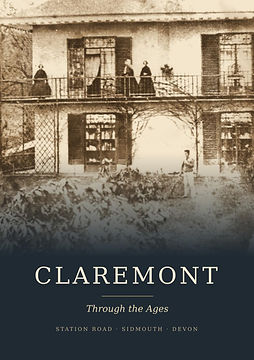
Claremont: Through the Ages
Sidmouth, about 1826. On a slope above the sea, men put their spades into the red earth and began to dig.
Nobody wrote down their names. Nobody wrote down who paid them, who drew the plan, or the year the house was finished. Everything points to 1826 or 1827, so the house they raised, Claremont, celebrates its bicentenary in 2027.
The property is Grade II listed, and is described as a stucco villa. It looks like stone. It is not, entirely: it is rubble, brick and timber under a smooth render, lined out to pass for stone, as the fashion was. It seems to have been built to be let, to visitors who came for the season, for the sea air and the society of a small and fashionable resort.
They came, and stayed, and went. A colonel who held the Victoria Cross. A baronet. Two daughters of an Earl. A Portland cement manufacturer and his family. And below stairs, the cooks and maids who kept it all running, remembered, if at all, by a line in the census.
In 1964 it became three homes. The fields around it are gone. The house is very much as it was.
And there is a photograph: three ladies on the balcony, in their best, looking down. Who were they?
By James Ogilvy Leacock. Paperback, 244 pages. ISBN 9798160026183.